AI Multi-Chain Portfolio Tracker
Web3 Data Pipelines, Dynamic Failovers & Risk Analyzer
A resilient multi-chain portfolio tracker and risk analyzer integrating live blockchain networks, market pricing APIs, sequential RPC fallback routing, and deterministic AI reasoning.
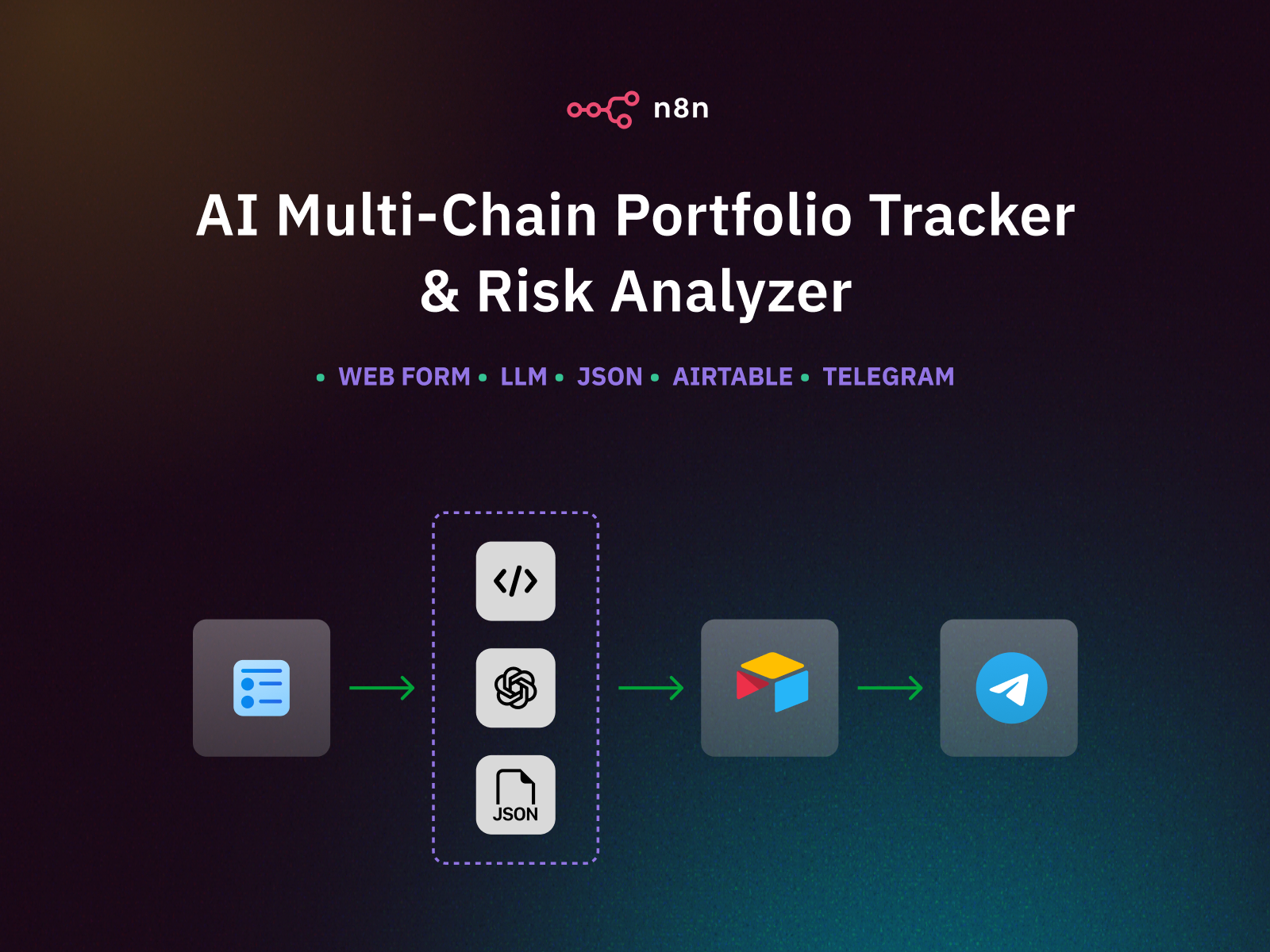
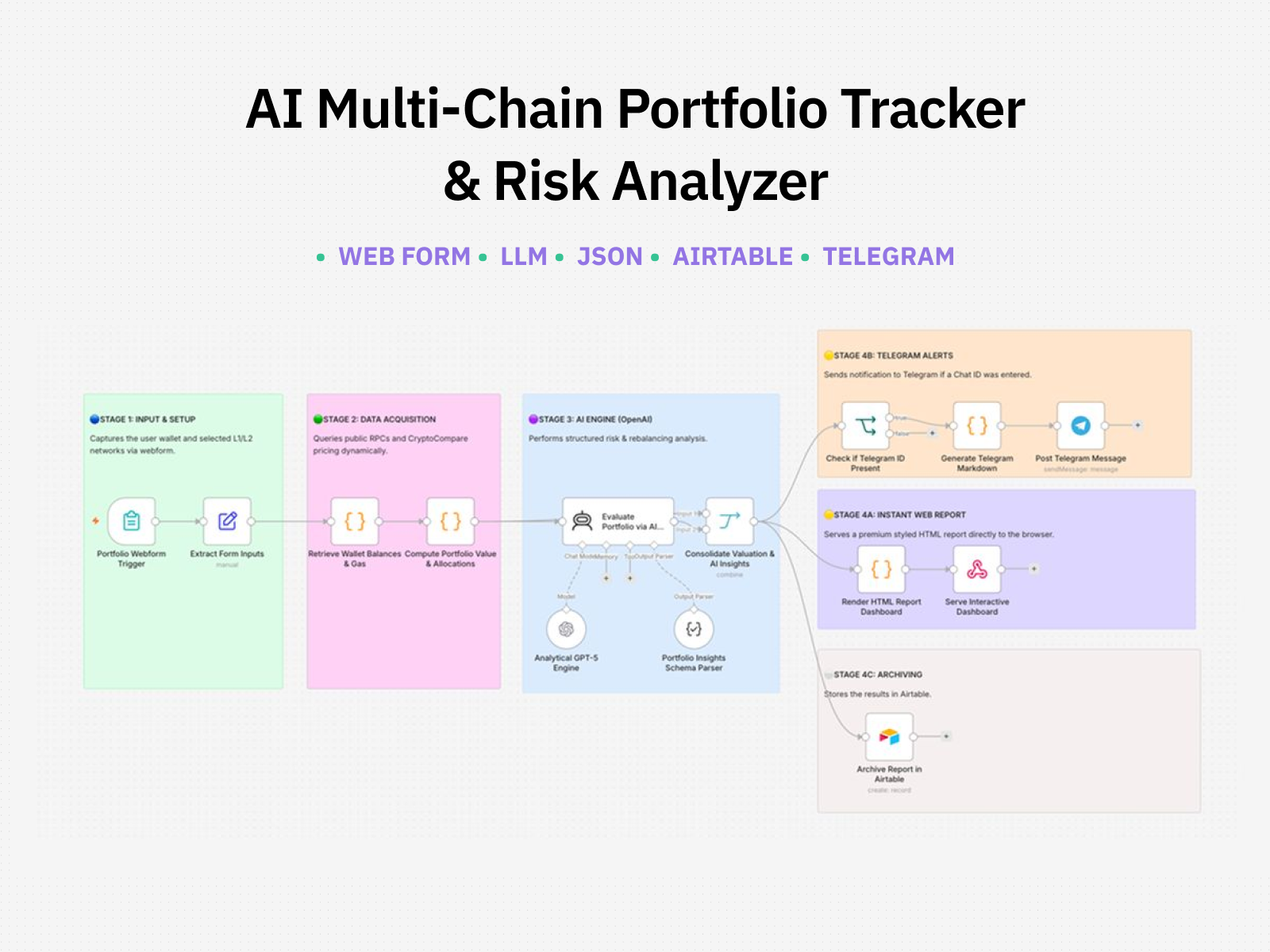
System Overview & Reliability Architecture
Integrating live blockchain networks, external market APIs, and LLMs into a single user-facing application presents unique reliability challenges. If a public RPC endpoint rate-limits or an API goes offline, the system must degrade gracefully rather than crash.
This system explores workflow design, interaction patterns, and resilient failover architectures to deliver comprehensive portfolio breakdowns, cross-chain balance aggregates, and deterministic risk evaluations.
Architectural Analysis & Design Pillars
1. Workflow Design: Dynamic Data Routing & Failovers
A common mistake in workflow design is relying on a single, static point of failure for external queries. For Web3 data ingestion, public RPC endpoints are notoriously unstable.
The workflow design addresses this by implementing a sequential failover pattern. The node configuration maps each network (Ethereum, Polygon, Arbitrum, Optimism, Base, Linea, Scroll, ZKsync) to a prioritized list of fallback endpoints. If a primary query fails or times out, the workflow automatically redirects to backup endpoints.
If all backups fail, the workflow design isolates the failure, logging the network as offline and proceeding with the remaining active chains instead of halting the entire execution.
2. Interaction Design: Synchronous Web Report Responses
Standard webhook workflows operate asynchronously, processing data in the background and returning a generic submission screen. To elevate the user experience, the interaction design was adjusted to a synchronous request-response pattern.
By configuring the trigger response mode to hold the connection, the browser tab remains active while backend calculations and AI evaluations run. The final node in the active path then delivers a dynamically rendered dashboard directly back to the user's browser.
3. AI Prompt & Schema Design
For financial analysis, LLMs must behave deterministically. To enforce this, the design applies two strict parameters:
Low Temperature (0.2): Restricts the model's creative variance, forcing logical, analytical reasoning.
Structured Output Schema: Enforces a JSON blueprint requiring the AI to return structured arrays for rebalancing recommendations and security warnings, preventing parsing errors downstream.
4. UI Design & Graceful Degradation
Good UI design accounts for backend failures. If the pricing API or the AI engine encounters downtime, the dashboard layout dynamically adapts.
The UI design is built to render partial reports. If the AI is unreachable, the system displays the wallet balances and USD calculations normally, but replaces the AI section with a styled warning box. This ensures a clean user experience rather than a broken page.
Multi-Chain Coverage & Resiliency Features
- Multi-Chain Ingestion: Queries balances across Ethereum, Polygon, Arbitrum, Optimism, Base, Linea, Scroll, and ZKsync.
- Sequential Failover: Automatically rolls over to backup RPC endpoints upon rate limiting or query timeouts.
- Fault Isolation: Offline chains are logged and skipped, guaranteeing that execution continues for remaining active networks.
- Deterministic Risk Scoring: Generates structured rebalancing cues and risk indicators with low temperature and strict schemas.
- Adaptive UI Feedback: Displays complete wallet and token metrics with graceful fallback notices if specific upstream services are unavailable.
Contact me
Have a question or want to work together?
Drop me a message.